











Fertilizer Selection
Fertilizers-synthetic
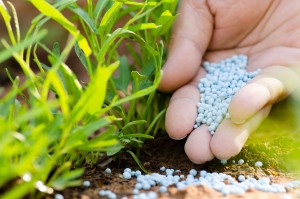
STARTER FERTILIZER – 16-16-16
Balanced ratio of Nitrogen, Phosphorus, and Potassium. Recommended starter fertilizer for new sod and seeding. Also good for gardens and flower beds.
PRO SPRING – 12-2-8 12% FE (25% slow release)
Commercial spring fertilizer with high Iron for moss control. Contains Hydrolene for extended releases.
Jump Start – 23-0-6 Phosphorous Free
The “Go To” formula for most maintenance needs. Faster response with 5.8% of the Nitrogen being a Nitrate for immediate availability to the plant.
Autumn – Elite 21-0-21
Fall fertilizer helps strengthen your lawn for the coming winter season.
DOLOPRIL – PELLETED LIME
Quick acting pelleted Dolomite Lime, supplies both Calcium and Magnesium-Carbonate. Easy to apply with a broadcast spreader. Apply in early spring or late fall to establish turf; or apply to soil when preparing for new sod or sod.seed.
WHAT DO THE NUMBERS MEAN?
All fertilizers have a label which list the percentages of the three major nutrients that they contain in the following order N-P-K. Which means that a fertilizer listing of 23-0-6, for example, is 23% N (Nitrogen), 0% P (Phosphorous), and 6% K (Potassium). Some fertilizers contain additional trace elements, slow release sources of nitrogen and/or organic sources of nutrients.
N = Nitrogen (N).
Nitrogen is the first number in the analysis of the bag. Nitrogen is a component of chlorophyll (responsible for green color of plants). Nitrogen is required for nearly all growth processes in turf. Nitrogen is important for new and established lawns. Top growth occurs at the expense of root growth, so excessive amounts of Nitrogen can restrict root growth.
P = Phosphorous (P2O5).
Phosphorous is the second number in the analysis. This nutrient is for root development and is especially important for young turf. The rapid growth associated with germination requires phosphorous, therefore is essential in starter fertilizers. Less is required in established turf.
K = Potassium (K2O).
Potassium, also know as Potash, is associated with the plant’s ability to withstand stress. When supplied to the plant along with adequate amounts of Nitrogen, potassium thickens the cell wall. This makes the plant better able to withstand drought, insects, disease and temperature extremes.
HOW MUCH DO I USE
- The amount of fertilizer to apply to established lawns is based on the nitrogen level.
- The recommended amount of nitrogen to apply for Western Washington is 4-6 pounds of “actual nitrogen” per 1000 sq. ft. of lawn area per year.
- Fertilizer should be applied 4-6 times per year, with each application providing approximately 1 lb of “actual nitrogen” per 1000 sq. ft.
- The nutrients on a bag of fertilizer are expressed as a true percentage by weight.
Example: 23-0-6 contains 23% of N, 0% of P, and 6% of K. This means that every 100 lbs of 23-0-6 contains 23% or 23 lbs of nitrogen (N), 0 lbs of phosphorous (P), and 6 lbs of potassium (K). (i.e. 100 lb x .23 (23% expressed as a decimal) = 23 lbs).
Therefore, Country Green Turf Farms need to apply 4.3 lbs of 23-0-6 fertilizer to get 1 lb of nitrogen on each 1000 sq. ft. lawn.